The Whale Team · 1 November 2026 · 8 min read
How to Run a Workshop With Whale.AI: A Moderator’s Practical Guide
A practical moderator playbook for Whale.AI workshops, with preparation steps, a 90-minute agenda, useful prompts, and techniques for turning contributions into clear next actions.
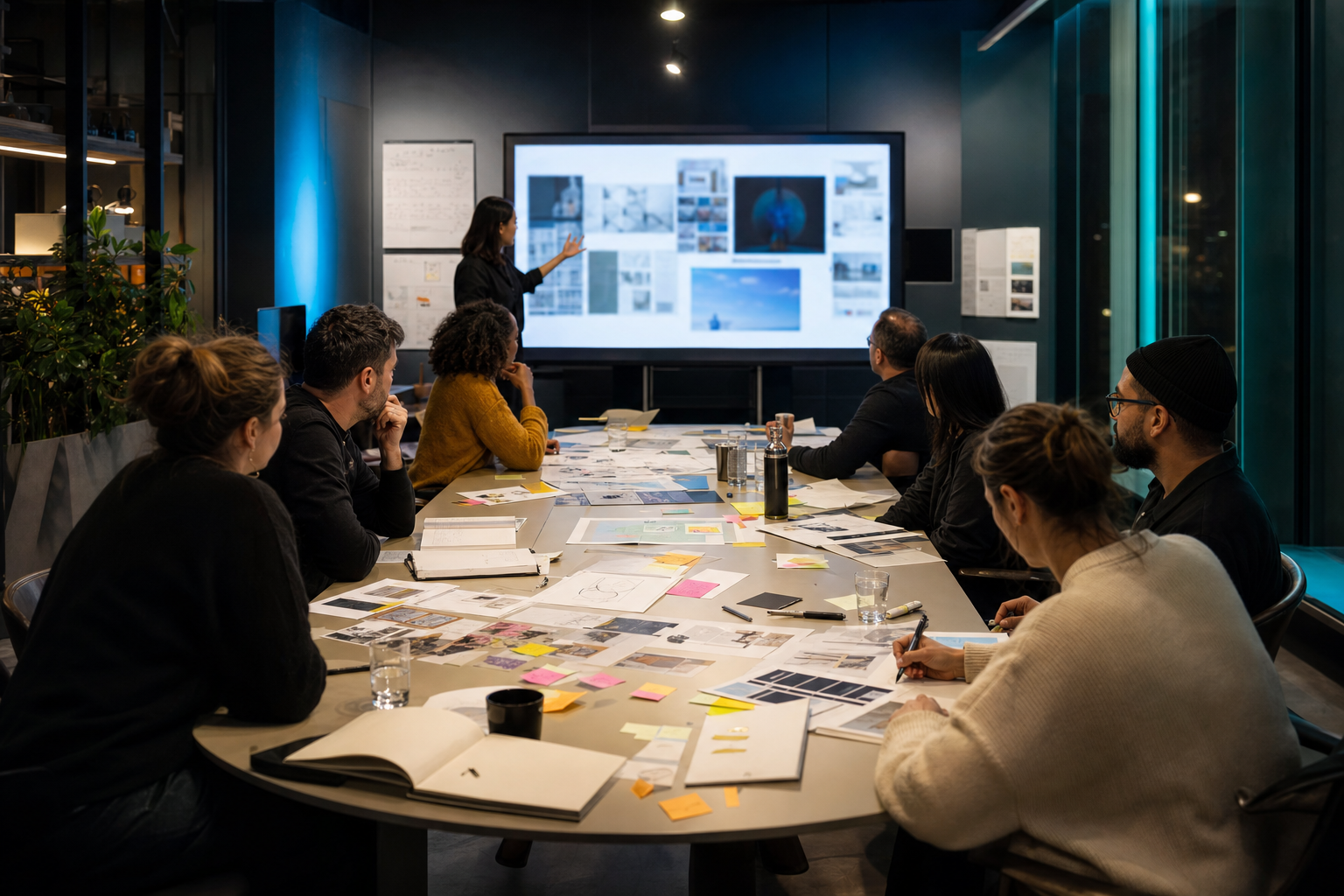
To run a useful Whale.AI workshop, define the decision before opening the room, prepare a small set of relevant evidence, and structure the session around individual contribution, shared exploration, and deliberate selection. Use Whale’s live collaboration and creative outputs to make thinking visible. The moderator remains responsible for participation, interpretation, pace, and a clear close.
Before the workshop: write a brief people can act on
Start with one decision the session can realistically move forward. “Explore the future of the brand” is difficult to moderate. “Choose two ways to make our refill proposition easier for first-time buyers to understand” gives participants an audience, a problem, and an output. Name the decision owner and agree which constraints are fixed.
Prepare a compact evidence pack: the brief, a few relevant research extracts, selected references, and essential brand or practical constraints. Explain what each source contributes. Participants need a shared starting point without spending the first half of the session reading a library.
Set up the Whale room and rehearse the contribution and output activities you plan to use. Test participant access, screen sharing, and any voice or visual workflow with the devices available. If you use a Whalet for pre-work, keep the task focused and bring the resulting contributions into the session brief. Explain how contributions will be used and avoid including unnecessary personal or confidential material.
- Write the decision, audience, constraints, and required output in one short brief.
- Agree selection criteria with the decision owner before seeing ideas.
- Assign a moderator and, where possible, a producer to manage access and capture.
- Prepare a plain-text contribution option and a shared view if someone cannot access the room.
- Send the purpose, preparation task, and participation expectations in advance.
A 90-minute agenda for a focused working session
The following agenda suits a small team working from prepared evidence toward two or three routes. Treat it as a starting point: use a longer session or separate workshops if participants need substantial research immersion or if the decision involves several audiences.
Keep the phases visible and announce the transition between them. People should know whether they are adding possibilities, clarifying meaning, or making a choice. Reserve the final ten minutes even if the exploration is lively; the close is where the workshop becomes actionable.
- 0–10 minutes | Frame the decision, explain how to contribute, and agree the working rules.
- 10–20 minutes | Review the evidence together and clarify what is known or uncertain.
- 20–35 minutes | Gather individual ideas and reactions before group discussion.
- 35–55 minutes | Explore selected ideas in Whale, making routes tangible through words or visuals.
- 55–70 minutes | Review emerging themes, correct the synthesis, and preserve disagreements.
- 70–80 minutes | Compare routes against the agreed criteria and select what moves forward.
- 80–90 minutes | Confirm outputs, owners, unanswered questions, and the next review date.
Open with a small contribution from everyone
Begin with a low-pressure task connected to the brief: “Choose one piece of evidence that changes how you see the problem, and explain why.” Demonstrate a contribution, then give participants a few quiet minutes to add their own. This checks that the workflow is usable and gives you a first view of the different perspectives in the room.
Ask people to think individually before showing a polished AI-generated direction. An early visual can become an anchor that later contributions merely refine. Independent starting points give the group a wider set of ideas to work with.
Make participation flexible. Someone who prefers a short written reaction should have as much room as someone comfortable speaking or making a visual. Invite quieter participants to add context without putting them on the spot, and ask frequent speakers to leave space for others.
Use prompts that uncover reasons
The most useful moderator prompt often follows the contribution. A participant says a concept feels reassuring; ask which detail creates that feeling and in what situation it would matter. A visual gets rejected; ask what the participant would keep, change, or remove. The reasoning is what makes the output useful as evidence.
When using AI to develop a route, specify the audience, source material, constraint, and purpose of the output. For example: “Using these research extracts, draft three ways to explain the refill process to a first-time buyer. Keep each route distinct, identify the supporting evidence, and label assumptions.” Review the response with the group before developing it further.
Avoid leading questions such as “Does this make the brand more premium?” Try “What does this suggest about the brand?” and then probe the answer. Keep generated concepts labelled as exploratory stimuli, so reactions are interpreted in that context.
- “What in the evidence led you to that idea?”
- “Which part would you change first, and why?”
- “Who might experience this differently?”
- “What would have to be true for this route to work?”
- “What evidence would make us reconsider?”
Moderate the synthesis as carefully as the discussion
Use an emerging synthesis as a proposal the group can inspect. Read back a theme and ask whether it reflects what participants meant. Check a few underlying contributions, especially where the wording is broad or the conclusion feels stronger than the evidence.
Separate observations, interpretations, and ideas for action. “Three participants struggled to explain the refill steps” is an observation from the session. “The proposition may feel complicated” is an interpretation. “Test a three-step visual” is a proposed action. Keeping those distinctions visible helps the next team understand what has actually been learned.
Do not let a repeated phrase erase a minority concern. Ask what has been omitted, which contributions do not fit the dominant theme, and whether the disagreement points to a different audience or situation. Workshop frequency is not a measure of market prevalence, and the room’s enthusiasm is not consumer validation.
Keep difficult moments productive
If one person dominates, pause for a short written round before taking more spoken contributions. If the group goes quiet, replace the broad question with a concrete comparison: “Which of these two routes is clearer, and what makes the difference?” Give people time to think before filling the silence yourself.
If an AI output looks impressive but drifts from the brief, return to the evidence and ask what it is meant to express. Reduce the task to one change rather than generating another large batch. If the synthesis misses the point, correct it with the group and retain the original contributions as the reference.
If the technology slows the room down, continue the activity through the shared screen or plain-text notes and bring the contributions back into the working record afterwards. A producer can handle access issues while the moderator protects the conversation. If disagreement persists, capture the competing routes and the evidence needed to choose between them.
Close with a decision record people can use
Return to the criteria agreed at the start. Compare routes on relevance to the audience, strength of evidence, distinctiveness, and practical feasibility. A quick preference vote can expose where the room leans, but the decision owner should explain what is selected and why. Record any material reservations.
Use the Whale output that fits the next conversation: an ideaboard for comparing territories, a storyboard for explaining an experience, or a concise synthesis for stakeholder alignment. Each selected route needs a short rationale, supporting evidence, an open question, an owner, and a next step. Avoid spending the close polishing an asset while leaving its purpose unresolved.
After the session, review the synthesis for accuracy and circulate the agreed outputs through the team’s normal process. Give participants a chance to correct misinterpretations. At the next review, check what was developed or tested and what changed as a result. That follow-through is a better measure of workshop value than the number of ideas generated.
- Selected route and the decision it supports.
- Supporting contributions and source material.
- Assumptions, disagreements, and questions still to test.
- Named owner, next deliverable, and review date.
Need a direct answer?
Explore Whale’s collaboration and AI workshop FAQ.
Find clear answers to common questions about digital collaboration platforms, creative workshops, evidence-led innovation, and generative AI.
Visit the FAQ