The Whale Team · 27 July 2026 · 8 min read
How to Run an Evidence-Led Innovation Workshop With AI
Plan and facilitate an innovation workshop that combines source material, live collaboration, AI-supported exploration, and clear next-step outputs.
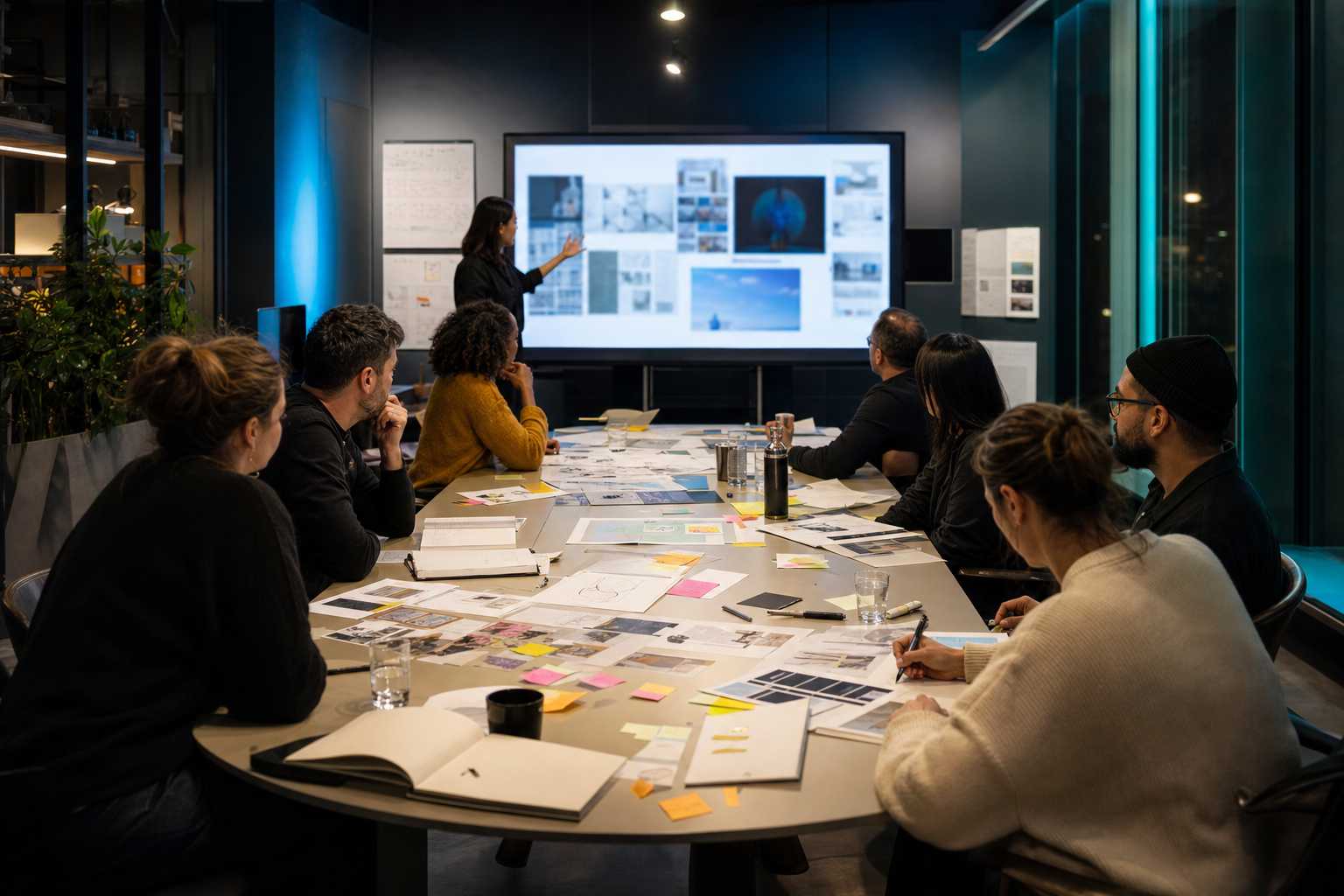
An evidence-led AI innovation workshop combines a clear decision, selected source material, guided collaboration, and a structured way to turn emerging ideas into routes. AI can help teams explore and organise possibilities, but facilitation and evidence remain responsible for deciding what is relevant, credible, and ready to develop.
Set up the decision before the room opens
Innovation workshops work best when they are designed around a decision rather than a generic desire for new ideas. State the audience, challenge, category context, constraints, and the type of output needed. A group that knows it is developing product territories will contribute differently from one exploring a brand proposition or communications platform.
Choose source material with care. Bring the research, category signals, visual references, prior concepts, or business constraints that will help people think productively. The goal is not to overwhelm the room with background. It is to make the evidence available when a participant wants to test, challenge, or build on it.
Decide in advance how the session will close. Will the group select two routes for development? Create a stimulus-ready concept set? Identify research questions? Clear outputs make the workshop feel like part of a wider workflow rather than an isolated event.
Use AI as a structured exploration partner
AI is most useful in a workshop when it helps people explore a defined space, not when it produces a flood of generic answers. Give it relevant source material, clear prompts, brand rules, and a role in the process. It can help translate a tension into possible routes, make a draft visualisation easier to discuss, or offer alternative ways to frame an opportunity.
Keep the human team in the loop. Ask people to explain what feels true, surprising, unhelpful, or off-brand about an output. Those reactions are part of the evidence too. The creative journey—prompts, edits, rejected options, and final choices—can reveal the language and preferences that matter to a team or participant group.
Whale’s live rooms and Whalets are designed around this kind of guided contribution. Teams can capture ideas, reactions, visual builds, and voice-led input while facilitators keep sight of the themes forming across the room.
Facilitate divergence and convergence differently
Divergence is the phase for generating options. Give people time to make connections, combine references, and propose routes without asking for instant consensus. Prompt them to add the evidence or assumption behind a suggestion so that strong ideas do not become detached from their rationale.
Convergence is a different activity. Cluster the material, name the emerging territories, and ask what each route makes possible. Compare routes against the workshop question, the selected evidence, and the practical constraints that matter. A route does not have to be finished to be valuable, but the reason for taking it forward should be clear.
Avoid treating the loudest contribution as the best one. A visible record of ideas and reactions makes it easier for facilitators to bring quieter signals back into the discussion and to distinguish broad energy from a genuinely useful opportunity.
- Diverge: generate, combine, and challenge possibilities.
- Cluster: identify recurring themes, language, and visual cues.
- Converge: compare territories against the decision criteria.
- Commit: assign an owner and next output for each selected route.
Close with a usable innovation output
The quality of the close determines whether workshop energy turns into progress. Summarise the strongest signals, state the territories selected, and record what needs validation. If a route is not being taken forward, capture why; that prevents the same debate from returning without new evidence.
Turn selected routes into an output that suits the next conversation. An ideaboard can help a team scan and compare options. A storyboard can make a narrative or experience easier to discuss. A concise synthesis can help align stakeholders before a new research or development step.
Because Whale connects collaboration with synthesis and creative output, teams can continue from the room into the next deliverable without manually rebuilding the evidence trail. That continuity makes the workshop more useful long after the session ends.
Need a direct answer?
Explore Whale’s collaboration and AI workshop FAQ.
Find clear answers to common questions about digital collaboration platforms, creative workshops, evidence-led innovation, and generative AI.
Visit the FAQ